
palletizer is an end-of-line packaging device used in industrial automated production lines. Its main function is to automatically and neatly stack bagged, boxed, and barrelled materials coming off the production line onto pallets according to a preset arrangement and number of layers, so as to facilitate subsequent forklift handling, warehousing, and transportation.
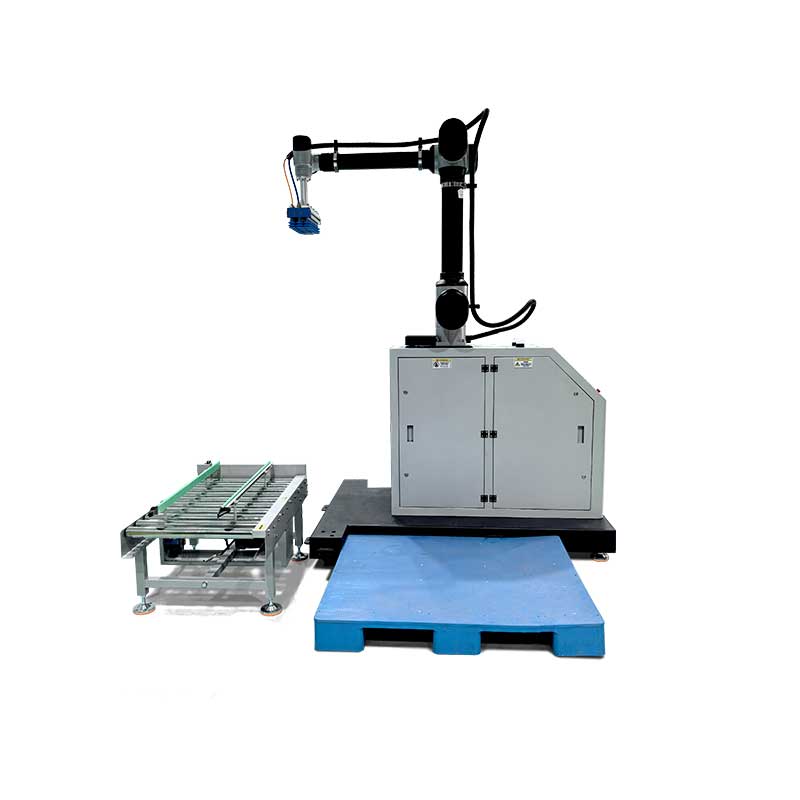
Working Principle
Conveying and Positioning: Packaged materials are precisely conveyed to the palletizing position via belt conveyors, chain conveyors, or roller conveyors. Sensors detect the material’s position and status.
Gripping/Pushing:
Robot Arm Type: A servo motor-driven robotic arm (articular or Cartesian type) with end effectors (such as clamps, vacuum suction cups, or hooks) grips the material.
Push-Plate/High-Level Type: Materials are pushed into designated layered frames using push plates, forming a neat layer.
Path Planning and Stacking: The control system (PLC or dedicated controller) moves the robotic arm or lifting platform to the designated position above the pallet and lowers it according to a preset palletizing pattern (such as staggered, rotary, or row-column).
Cyclic Operation: After completing one layer, the pallet lowers (or the robotic arm rises) to continue stacking the next layer until the set height or number of layers is reached.
Output: Full pallets are removed via a conveyor line and transported by forklifts, while empty pallets are automatically replenished.
Palletizer of Types
Based on their structure and motion, palletizers are mainly classified into the following categories:
- Robot Palletizer: Uses a multi-axis industrial robotic arm (usually 4 or 6 axes).
Features: High flexibility, small footprint, adaptable to various products and irregular palletizing patterns, easy task switching. Suitable for production lines with limited space or high-variety, low-batch production.
- High-level Palletizer: Materials are lifted to a high position, grouped and layered on the top layer, and then lowered onto a pallet.
Features: Extremely high speed, good stability, suitable for single-product, high-volume, high-speed production (e.g., beverages, flour mills).
- Low-level Palletizer: Groups and stacks materials at ground level.
Features: Simple structure, easy maintenance, but relatively slow speed and larger footprint.
- Gantry/Cartesian Coordinate Palletizer: Moves along the X, Y, and Z linear axes.
Features: Low cost, high precision, suitable for heavy loads or specific arrangement requirements.
Palletizer of Advantages
High Efficiency: Capable of continuous 24-hour operation, far exceeding manual labor speeds (high-speed models can perform thousands of grips per hour).
Reduced Costs: Significantly reduces the number of handling workers, lowering long-term labor and management costs.
Standardization and Safety: Neat and aesthetically pleasing palletizing, facilitating efficient use of warehouse space; avoids lower back strain, workplace injuries, and product damage from drops caused by manual handling.
High Adaptability: Especially robotic palletizers, which can quickly adapt to different product sizes and weights through program modifications.
Application
Palletizers are widely used in almost all industries requiring bulk goods stacking:
Food and Beverage: Cases of beer, beverage bottles, instant noodles, bags of grains, oils, rice, and flour, etc.
Chemical Industry: Fertilizer bags, plastic granule bags, paint buckets, grease buckets, etc.
Building Materials Industry: Cement bags, tile boxes, insulation materials, etc.
Pharmaceuticals and Daily Chemicals: Medicine boxes, laundry detergent bottles, tissue boxes, etc.
Cold Chain Logistics: Replacing manual labor in low-temperature frozen storage facilities, avoiding the need for personnel to work in extreme environments.
Conclusion
Palletizer are the core equipment for factories to achieve “unmanned” or “less manned” packaging production lines, transforming heavy manual labor into precise automated operations.