
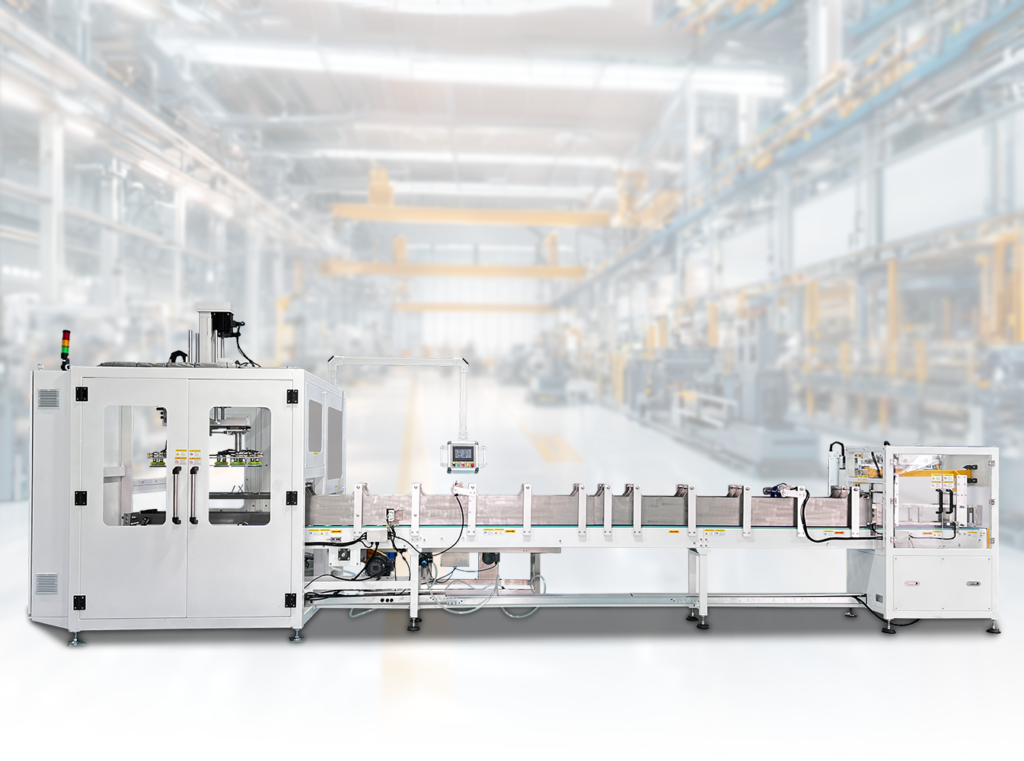
An automatic case packer is a secondary packaging machine that loads finished products into shipping cases and seals them with minimal manual intervention. It sits at the end of the production line—after primary packaging and before palletizing—and performs case erecting, product collation, loading, and sealing in one automated sequence.
Table of Contents
- What Is an Automatic Case Packer?
- Core Working Principle
- Types of Automatic Case Packers
- Advantages of Automatic Case Packers
- Applications of Automatic Case Packers
- Conclusion
What Is an Automatic Case Packer?
An automatic case packer is an end-of-line machine that places finished products—bottles, pouches, cartons, trays, or cans—into corrugated shipping cases and seals them for distribution. Unlike semi-automatic systems, where an operator may still load the product, a true automatic case packer handles collation, case erection, loading, and sealing within one controlled process. It ensures every case is packed to the same specification and keeps pace with upstream production equipment.
Core Working Principle
Most automatic case packers follow four steps: collate → erect → load → seal.
· Collate: Products are grouped into the required rows and layers.
· Erect: A flat corrugated blank is opened and the bottom flaps are sealed.
· Load: The product group is placed into the case by top-load, side-load, drop, or robotic handling.
· Seal: The case is closed and sealed with tape or hot-melt adhesive, then discharged to labeling or palletizing.
PLC-based controls coordinate the sequence, while servo drives ensure precise, repeatable movement. Vision systems are increasingly used to verify product placement, read codes, and support traceability.
Types of Automatic Case Packers
The four main types differ in how the product enters the case:
· Top-load case packers lower products into an open case from above. Ideal for fragile, irregular, or mixed-SKU products; generally slower than side-load systems.
· Side-load case packers push products horizontally into a pre-erected case. Well suited to rigid containers and high-speed lines.
· Wrap-around case packers form the case around the product from a flat blank. Material-efficient and compact, best for uniform, high-volume products.
· Robotic case packers use robot arms, often with vision guidance, to pick and place products. Flexible for multi-SKU lines and complex pack patterns, with higher upfront cost.
A less common bottom-load configuration supports delicate products from underneath and is used for flexible pouches, baked goods, and lightweight medical items.
Advantages of Automatic Case Packers
· Higher throughput: Matches upstream line speed and supports continuous multi-shift operation.
· Consistent quality: Eliminates miscounts and inconsistent pack patterns; reduces product damage.
· Labor optimization: Redeploys operators to supervision, inspection, and maintenance.
· Measurable ROI: Typical payback is 12–24 months, depending on labor costs and volume.
· Easy integration: Connects with collators, labelers, checkweighers, and palletizers; recipe-driven changeovers support new case sizes and SKU changes.
Applications of Automatic Case Packers
· Food and beverage: High-speed handling of bottles, cans, pouches, cartons, and trays; stainless-steel and washdown options for hygiene.
· Pharmaceutical and healthcare: Vision verification, code reading, labeling, and serialization compliance.
· E-commerce and logistics: High-volume parcel preparation, carton sealing, and mixed-SKU order fulfillment.
· Household and personal care: Rigid containers at high speeds, with quick-change tooling for diverse product portfolios.
Conclusion
The automatic case packer has become a core component of modern end-of-line packaging. It delivers consistent throughput, reduces manual labor, protects product quality, and integrates into automated production lines. When choosing a system, start with three variables: product form, line speed, and SKU mix. Uniform high-volume products favor side-load or wrap-around systems; fragile or mixed-SKU products favor top-load or robotic solutions. If the product mix is expected to change, flexibility should take priority over raw speed. The right machine is the one that fits the line—not the other way around.